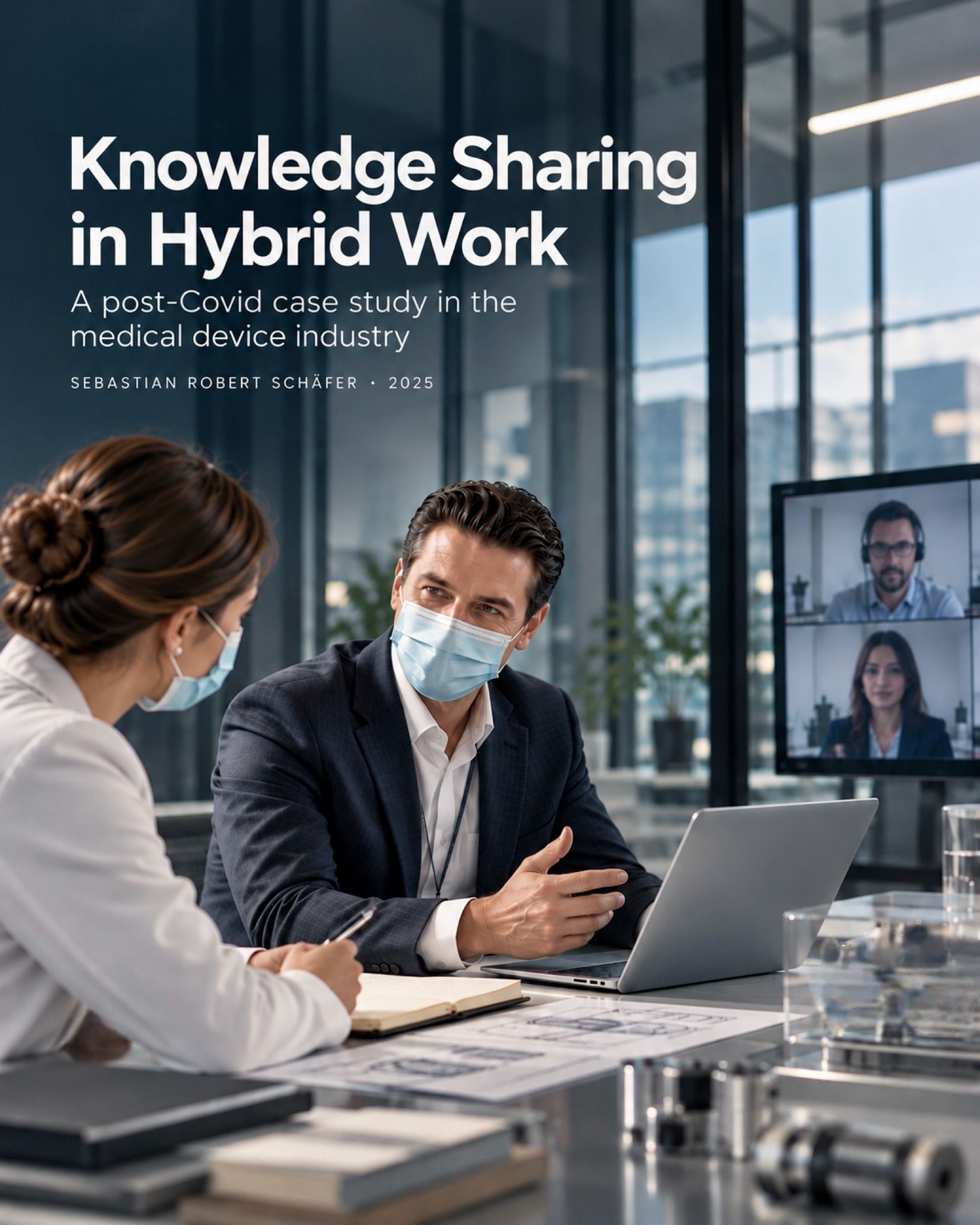
 When organisations moved to hybrid work, most of them focused on the visible questions: how many office days, which collaboration tools, what to do with empty desks. A less visible question turned out to be far more consequential. What happens to the knowledge that used to travel through hallway conversations, spontaneous whiteboard sessions and a quick question across the desk?
Doctoral research by Dr. Sebastian Schäfer, an alumnus of the European Institute of Management (EIM), tackles exactly this question. His dissertation, Knowledge Sharing Under Hybrid Working Conditions (Post Covid-19), is independently published and indexed on ProQuest. Its central contribution is a model with a memorable name, the Hybrid Knowledge Sharing Puzzle, and a sharp implication for leaders: knowledge sharing in hybrid organisations does not fail because of one missing tool. It fails when one piece of a larger system is missing.
The Problem Behind the Video Call
Reduced face-to-face interaction has profoundly changed how organisations work. Schäfer's research begins from that observation and narrows it to a specific research problem: how knowledge sharing can take place under hybrid working conditions, and what managers and team members need to understand in order to adapt to this new way of working.
The question is far from academic. In knowledge-intensive industries, an organisation's competitive position depends on how quickly expertise moves from the people who have it to the people who need it. When that flow slows down, the damage rarely shows up immediately in a dashboard. It shows up months later, in duplicated work, repeated mistakes, slower onboarding and decisions made without the right information.
A Deep Look Inside One Industry
To study the phenomenon in depth, Schäfer chose a qualitative single-case study design focused on employees in the medical device industry, a sector where knowledge is highly specialised, heavily regulated and closely tied to product quality and patient safety. The study explored employees' own perceptions of how they share knowledge under hybrid working conditions, based on semi-structured interviews within a Swiss medical device company. A deliberate design choice strengthens the evidence: all participants had joined the company before 2020. They could therefore compare knowledge sharing before and after the shift to flexible work, rather than describing hybrid work without a reference point.
The research is grounded in two established theoretical lenses:
- Social capital theory, which explains how relationships, networks and trust create value inside organisations.
- Social exchange theory, which describes how people weigh what they give and receive in their interactions, including the decision to share or withhold knowledge.
Both lenses point to the same underlying insight. Knowledge sharing is not merely a technical transfer of information. It is a social act that depends on relationships, reciprocity and trust, all of which are affected when colleagues see each other less often.
Four Pieces of the Puzzle
From this foundation, the dissertation introduces the Hybrid Knowledge Sharing Puzzle, consisting of four interlocking elements:
- Digital tools and infrastructure – the technical backbone that makes knowledge accessible regardless of location.
- Corporate support – the organisational commitment, resources and policies that enable knowledge sharing rather than leaving it to chance.
- Communication and sharing culture – the shared norms that determine whether people actively share what they know.
- Hybrid leadership – the role of leaders in shaping how teams collaborate and exchange knowledge across physical and digital settings.
The metaphor of a puzzle is deliberate. Each piece is necessary, but none is sufficient on its own. An organisation can invest heavily in collaboration platforms and still see knowledge stagnate if the culture does not reward sharing. A strong team culture can be undermined if leaders do not adapt their style to hybrid conditions. And even excellent leaders struggle when corporate support is missing.
What Employees Actually Said
One of the most practically relevant findings concerns employees' attitudes. Participants welcomed the hybrid work model and emphasised its benefits. At the same time, they acknowledged the importance of social and in-person interaction at the office.
This combination is important for leaders who frame the debate as a binary choice between "return to office" and "remote first". The research suggests that employees are not asking for one or the other. They value flexibility and, at the same time, recognise that some forms of knowledge exchange depend on being physically together.
The study also identifies the complex and interconnected nature of hybrid knowledge-sharing dynamics. It highlights challenges that are specific to hybrid work, as well as barriers that can block effective knowledge sharing. In other words, hybrid work does not simply make old problems slightly worse. It creates new patterns that require new management responses.
From Insight to Daily Practice
What distinguishes Schäfer's work from much of the general commentary on hybrid work is its practical orientation. The dissertation provides actionable insights for daily knowledge-sharing activities and contributes a conceptual framework for knowledge sharing in hybrid work.
For managers, the puzzle can serve as a simple diagnostic. When knowledge sharing in a team feels slow or fragmented, four questions point to the likely gap:
- Do people have the tools and infrastructure to find and share knowledge easily from anywhere?
- Does the organisation provide visible support for knowledge sharing, or is it treated as an unpaid extra?
- Is there a culture in which sharing knowledge is expected and valued?
- Are leaders practising a form of hybrid leadership that actively connects people, rather than managing them as isolated individuals?
The value of this diagnostic lies in its systemic view. Many organisations respond to knowledge-sharing problems by buying another tool. The puzzle model suggests that the more effective response often lies in one of the other three pieces.
Why Practitioners Make Strong Researchers
Schäfer's dissertation is a strong example of what applied doctoral research can achieve. It takes a problem that thousands of organisations are experiencing in real time, studies it with an established qualitative methodology and translates the result into a framework that practitioners can use immediately. Schäfer's own background shows why: according to his EIM profile, he built his career as a project manager and project management consultant, including years as an expatriate in Asia managing complex international development projects, and he is a member of the EIM Advisory Board.
That combination of academic rigour and professional relevance is at the heart of EIM's doctoral programmes. Candidates who want to make an original contribution to management theory, for example on knowledge management, social capital or organisational behaviour, typically choose the PhD in Management. Those who want to apply research directly to a business challenge in their own organisation often choose the Doctor of Business Administration (DBA). EIM explains the difference between both paths in its guide on DBA vs. PhD in Management.
For leaders in the healthcare and life-sciences environment, where Schäfer's case is situated, the MBA in Health Care Management builds the management foundation for leading teams in highly regulated, knowledge-intensive settings. Managers who want to sharpen their leadership approach specifically can consider the Postgraduate Certificate in Strategy and Leadership.
Part of a Verifiable Research Record
Dr. Schäfer's dissertation is one of a growing number of EIM doctoral works that are publicly indexed and can be checked by anyone. The EIM Research Institute also includes it in its analysis of 19 doctoral dissertations, which maps what EIM doctoral research contributes to theory and practice. EIM has explained why this matters in its overview of dissertations powering the EIM Research Institute, and the complete list of published alumni dissertations is available on the EIM student outcomes page.
Conclusion
Hybrid work is no longer an experiment. It is the default operating model for a large share of knowledge workers, and it will remain so. The organisations that thrive in this model will not be those with the most sophisticated collaboration software, but those that understand knowledge sharing as a system of tools, support, culture and leadership.
Dr. Sebastian Schäfer's Hybrid Knowledge Sharing Puzzle gives leaders a clear way to see that system and to find the missing piece in their own organisation.
Want to research the questions shaping your own workplace? Book a one-on-one consultation to discuss which EIM doctoral or master's programme fits your goals.