The Biennale Crisis: Neutrality Under Pressure
The Venice Biennale, founded in 1895 and widely regarded as the most prestigious international contemporary art exhibition in the world, has long stood at the intersection of culture, politics, and institutional authority. Often described as the “Olympics of the art world,” it is both a platform for artistic expression and a stage for national representation.
In 2026, that role became the source of one of the most significant institutional controversies in its 131-year history. The Russian Pavilion, closed since Russia’s full-scale invasion of Ukraine in 2022, was permitted to reopen for the first time in six years. Critics, including a coalition of civil society organizations, argued that the reopening could not be treated as a purely artistic decision. They viewed it as a form of soft-power rehabilitation for a state engaged in ongoing war, systematic cultural erasure, and documented international crimes.
The pavilion’s own history made the controversy even more charged. Designed by architect Alexey Shchusev and erected between 1913 and 1914, the Russian Pavilion is one of the original national pavilions in the Biennale’s Giardini. It had previously been closed in 1922, from 1938 to 1954, and again between 1978 and 1980. In 1926 and 1936, it hosted exhibitions of Italian Futurism curated by Filippo Tommaso Marinetti, underlining its long connection to ideologically charged cultural politics.
After Russia’s annexation of Crimea in 2014, the pavilion became a site of protest, most notably when Ukrainian artists occupied it in 2015. Following the full-scale invasion of Ukraine in February 2022, Russia did not participate in the 2022 or 2024 editions of the Biennale. The 2026 reopening therefore took place in a context of ongoing warfare and intense international scrutiny.
The 61st Venice Art Biennale, curated by Koyo Kouoh under the theme “Stranieri Ovunque — Foreigners Everywhere,” was intended to explore belonging, displacement, and the universality of human experience. That curatorial aspiration sharpened the ethical dilemma: some forms of institutional presence carry political consequences that cannot be neutralized by universalist language.
Alterocentric Business Ethics as an Evaluation Framework
This analysis is grounded in the framework of Alterocentric Business Ethics, developed by Dr. Burkard Schemmel in his 2026 doctoral study on the impact of ethical conduct on the financial performance of European firms. Conducted at the European Institute of Management, the study examined 309 European firms and found a statistically significant positive correlation between ethical business conduct and financial performance, with p-values below 0.0001 across all measured dimensions.
Rooted in Freeman’s 1984 stakeholder theory, alterocentrism is defined as an ethical orientation that gives “the other” primacy in business considerations. In organizational terms, this means decisions are evaluated not by their convenience for the institution, but by their consequences for all affected stakeholders.
Schemmel defines business ethics as “the moral course of conduct that steers decision-making processes in organizations whenever confronted with moral dilemmas and competing interests. Ethical business decisions must consider the immediate consequences and their long-term effects on all stakeholders: customers, employees, shareholders, and communities.”
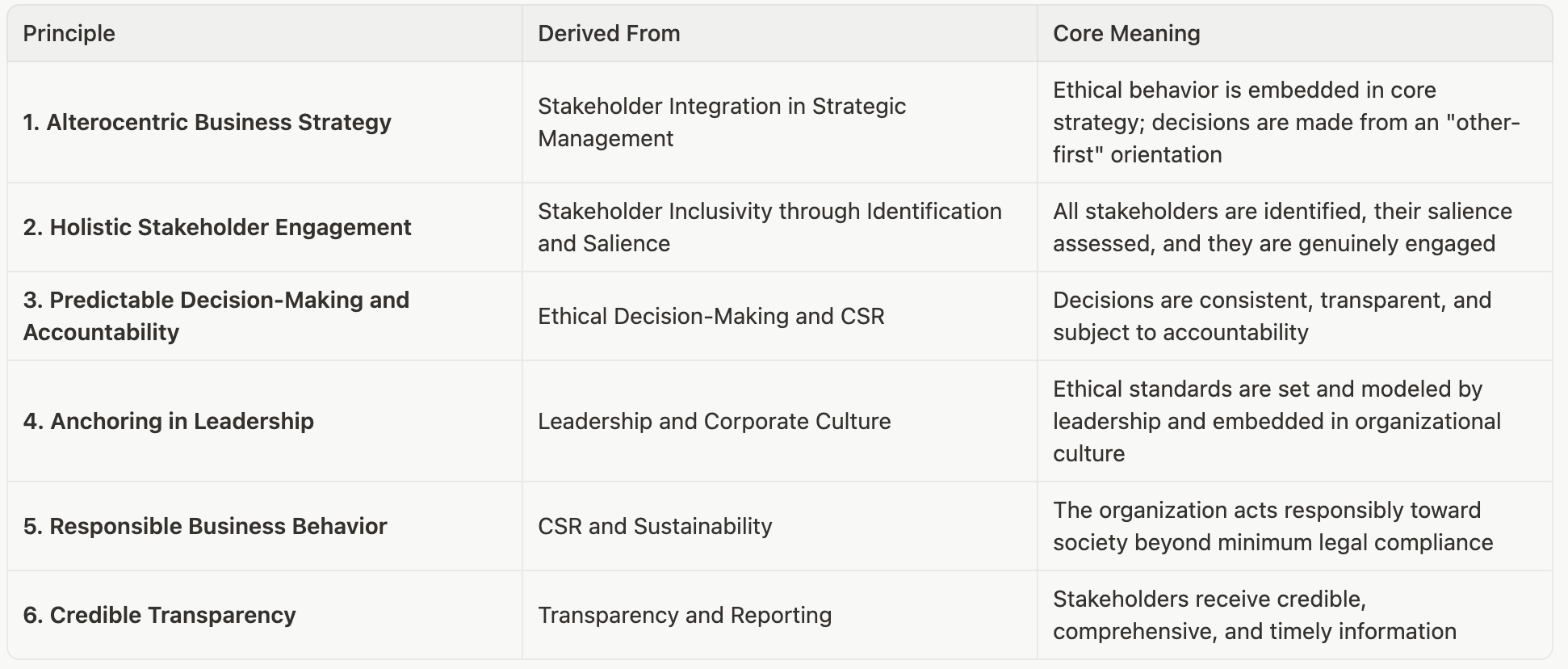
The framework is operationalized through six principles: Alterocentric Business Strategy, Holistic Stakeholder Engagement, Predictable Decision-Making and Accountability, Anchoring in Leadership, Responsible Business Behavior, and Credible Transparency.
Applied to the Biennale case, these principles shift the question away from whether the institution could formally justify its decision. The stronger question is whether the decision actively considered and mitigated harm to the most vulnerable stakeholders while preserving the Biennale’s long-term ethical integrity.
Six Ethical Leadership Lessons from the Russian Pavilion
The first principle, Alterocentric Business Strategy, requires ethical behavior to be embedded in the organization’s core strategy. For the Biennale, this meant evaluating the reopening of the Russian Pavilion through the lens of affected stakeholders, including Ukrainian artists, human rights defenders, and the international artistic community. Instead, the decision appeared to prioritize the preservation of the Biennale’s identity as a universal platform.
The second principle, Holistic Stakeholder Engagement, requires genuine engagement with all relevant stakeholders. In this case, the stakeholder environment included national governments, the international artistic community, civil society organizations, Ukrainian artists and cultural workers, the general public, media, and EU institutions that partly fund the Biennale. The jury’s collective resignation showed how seriously this engagement failed. The civil society organizations that signed the International Partnership for Human Rights statement also represented a salient stakeholder group whose concerns were not adequately addressed before the decision was made.
The third principle, Predictable Decision-Making and Accountability, requires clear and consistent ethical frameworks before a crisis develops. The Biennale’s approach was reactive. Its decision to restrict the Russian Pavilion’s opening to the vernissage period while keeping the possibility of award recognition open was widely perceived as an attempt to balance incompatible positions without a transparent principle.
The fourth principle, Anchoring in Leadership, requires leaders to set ethical standards, model them, and take visible ownership of difficult decisions. The Biennale’s leadership framed its decision through abstract institutional principles, but the communication did not sufficiently acknowledge the consequences of the choice or the legitimacy of stakeholder concerns.
The fifth principle, Responsible Business Behavior, requires conduct beyond minimum legal compliance. The International Partnership for Human Rights argued that access to the Russian Pavilion was effectively restricted in order to circumvent EU sanctions, while award recognition remained possible. From an alterocentric perspective, this reflected a failure to consider broader societal responsibilities.
The sixth principle, Credible Transparency, requires honest, comprehensive, and timely communication. In this case, the arrangements concerning opening hours and award eligibility were not clearly communicated in advance. The Biennale did not publish the ethical criteria, stakeholder consultation process, or specific mitigation measures that would have allowed stakeholders to understand and evaluate its decision.
Why the Case Matters Beyond the Art World
The core ethical question is whether an institution can legitimately claim neutrality when its decisions provide a platform for actors engaged in severe violations of international norms. This question applies far beyond cultural diplomacy. In business, a similar dilemma arises whenever an organization decides whether to maintain a relationship with a partner, client, or supplier whose conduct is deeply controversial.
The temptation is to rely on formal compliance: no law is broken, and standard practices continue. The Biennale case shows why that position can become ethically and reputationally fragile when the consequences are visible, significant, and contested.
The controversy was further complicated by parallel disputes involving the Israeli and U.S. pavilions. The Biennale announced that artists from countries whose leaders face ICC proceedings would not be considered for awards, but the international jury resigned after objections and legal threats from the Israeli pavilion over potential exclusion from awards. These developments exposed the risks of ad-hoc ethical decision-making. Different standards, applied under shifting political pressure, weaken credibility and accountability.
The final evaluation is therefore not simply about whether Russia should have been excluded. Reasonable people can disagree on that question. The ethical failure lies in the process: insufficient stakeholder engagement, inconsistent decision-making, limited leadership ownership, and a lack of credible transparency.
For senior leaders, the practical lesson is clear. Ethical decision-making in polarized environments cannot be reduced to inclusion or exclusion. It requires a structured process that centers affected stakeholders, applies consistent standards, and communicates decisions openly.
References retained from the original article include Freeman’s Strategic Management: A Stakeholder Approach; Schemmel’s 2026 doctoral dissertation at EIM – European Institute of Management; Schemmel and Bredemeier’s 2024 articles in the European Journal of Management, Leadership and Health Care; Schemmel’s 2025 study on ethically operating businesses in Europe; the International Partnership for Human Rights statement on Russia’s exhibit at the 2026 Venice Biennale; and the additional cited works by Aguilera, Rupp, Williams, and Ganapathi; Meixell and Luoma; Sferrazzo, Ruffini, and Fici; and Wikipedia’s entry on the Russian Pavilion.
The article also draws on research conducted at and in association with the EIM Institute for Societal Performance Development and the Alterocentric Foundation.